
Which Chamblee Public Records Are Open
Georgia law starts with a broad rule: agency records are open unless a statute, court order, or listed exemption closes them. That rule covers electronic data and records held by a contractor doing agency work. It does not make every field public. Chamblee public records can therefore range from city permits to DeKalb deeds, but access changes by record set and custodian.
| Record set | Official keeper | Web access | Other access |
|---|---|---|---|
| City administration and permits | Chamblee departments | GovQA request center; permit gateways | Focused city request |
| Deeds, liens, plats, UCCs | DeKalb Superior Clerk | Landmark, 1979 onward; alpha scans, 1961-1977 | Research room, mail, eCertification |
| Property and tax | DeKalb Appraisal, Tax, and GIS | Owner, address, or parcel tools | Department records request |
| Court files | Chamblee Municipal and DeKalb courts | City route; county provider account | Clerk counter or archives |
| Birth, death, marriage, divorce | Georgia DPH, Probate, Superior Clerk | Request instructions, not an open certificate index | Application, counter, or court file |
| Police incident reports | DeKalb Police or city custodian | Records-request route | Email, phone, or fax where published |
Restricted material includes birth certificates, adoption and juvenile files, sealed court cases, recorded military discharge papers, protected voter addresses, and motor-vehicle personal data controlled by federal law. Social Security numbers, full birth dates, payment data, and similar identifiers are also commonly withheld or redacted. A blank online result may reflect restricted access or incomplete coverage, not the absence of a record.
Chamblee Records in Landmark
The DeKalb County Clerk of Superior Court records deeds, plats, condominium floor plans, UCC filings, liens in the General Execution Docket, and other title instruments. Its Landmark official-record index offers several routes into that collection. An index points to a filing; it is not always the filed image or a certified copy.
| Search choice | Best input | Useful result |
|---|---|---|
| Name | Grantor or grantee spelling variants | Documents tied to a party |
| Document | Instrument type | Narrowed filing class |
| Book and page | Known citation | Specific recorded instrument |
| Parcel ID | Appraisal or GIS key | Parcel-linked filings |
| Filing date | Date range | Records entered in that span |
| Clerk file number or legal | Known clerk reference or land description | Exact or land-based match |
The portal itself advises trying every spelling variation. Electronic records run from 1979 forward. Scanned grantor and grantee books cover April 1, 1961, through December 31, 1977. The apparent 1978 break must be checked with the clerk. Physical land records begin in 1842.
The manifest-captured Landmark search screen shows the official starting point for those modes.
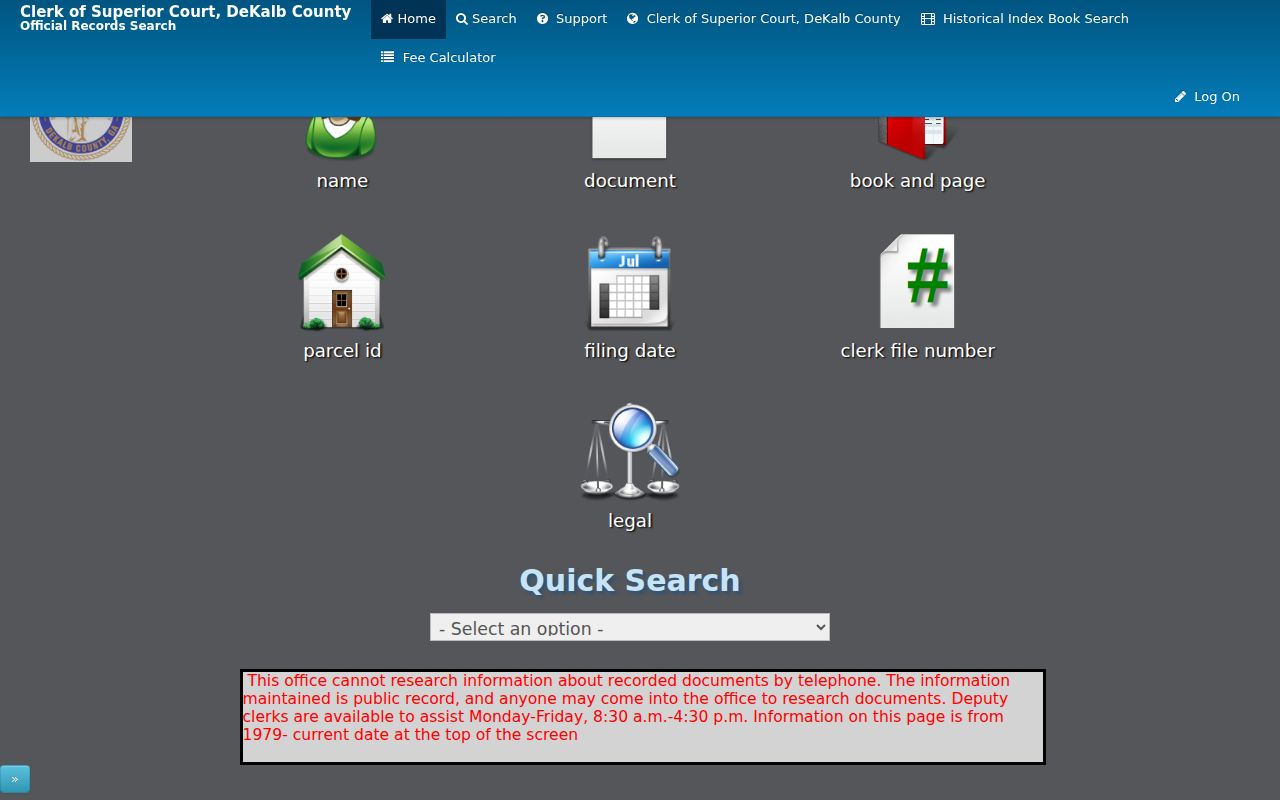
That portal view helps separate a free index search from the later task of ordering an informational or certified instrument.
Note: For 1978 or an uncertain spelling, use the clerk’s research room rather than treating an online miss as proof.
Chamblee Property Records by Function
Property facts are split across several DeKalb systems. The Property Appraisal search accepts an owner name, address, or Parcel ID and supplies assessments, characteristics, and notices. A parcel is a mapped unit of land, while a situs address is its physical location. The tax mailing address may differ from the situs.
The Property Mapping and Land Records service handles parcel geometry and tax-district context. GIS does not issue deeds, plats, surveys, or binding boundary decisions. Take its Parcel ID or land reference to Landmark and the clerk. The Tax Commissioner view can add current-owner mailing information and billed, paid, or due amounts.
The captured DeKalb appraisal gateway identifies the county’s owner, address, and parcel route.
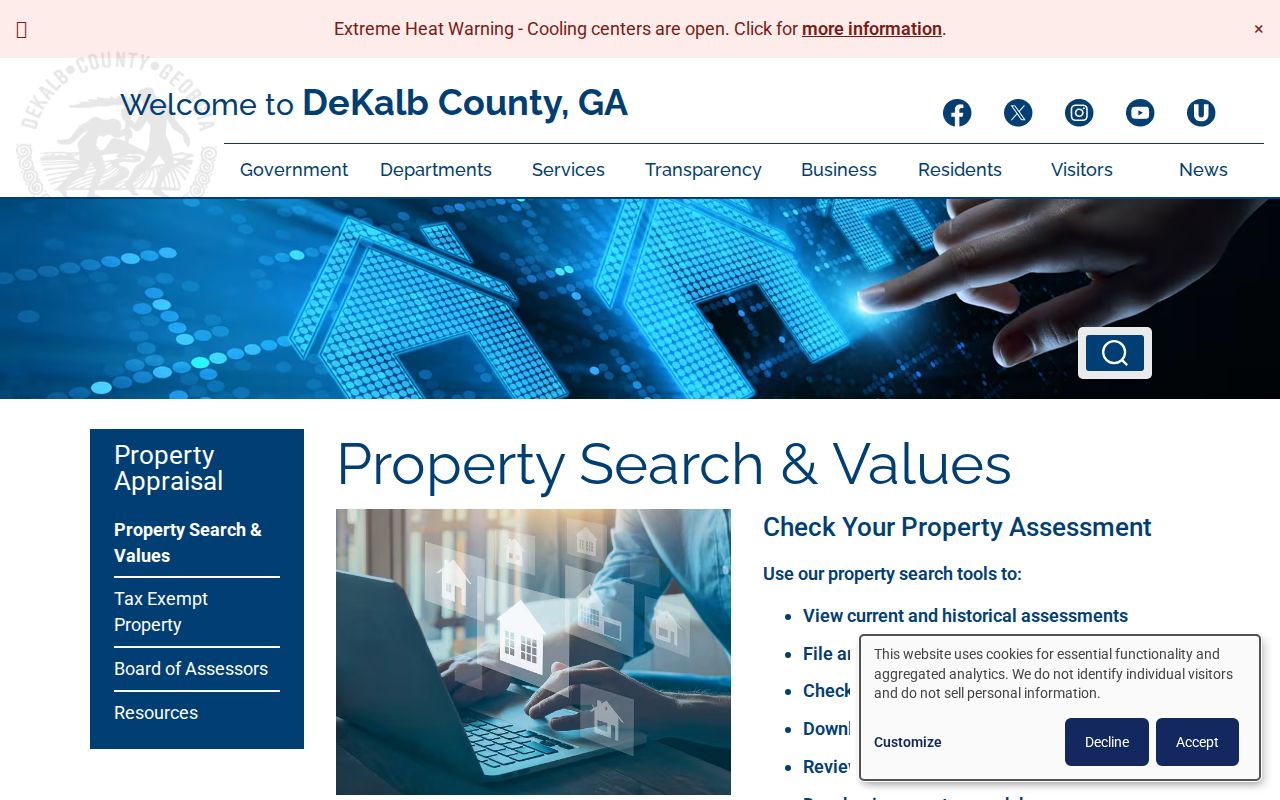
Use that search to identify the parcel, then move to GIS or recorded instruments only when those sources answer the next question.
The county also publishes a GIS and land-record routing page.
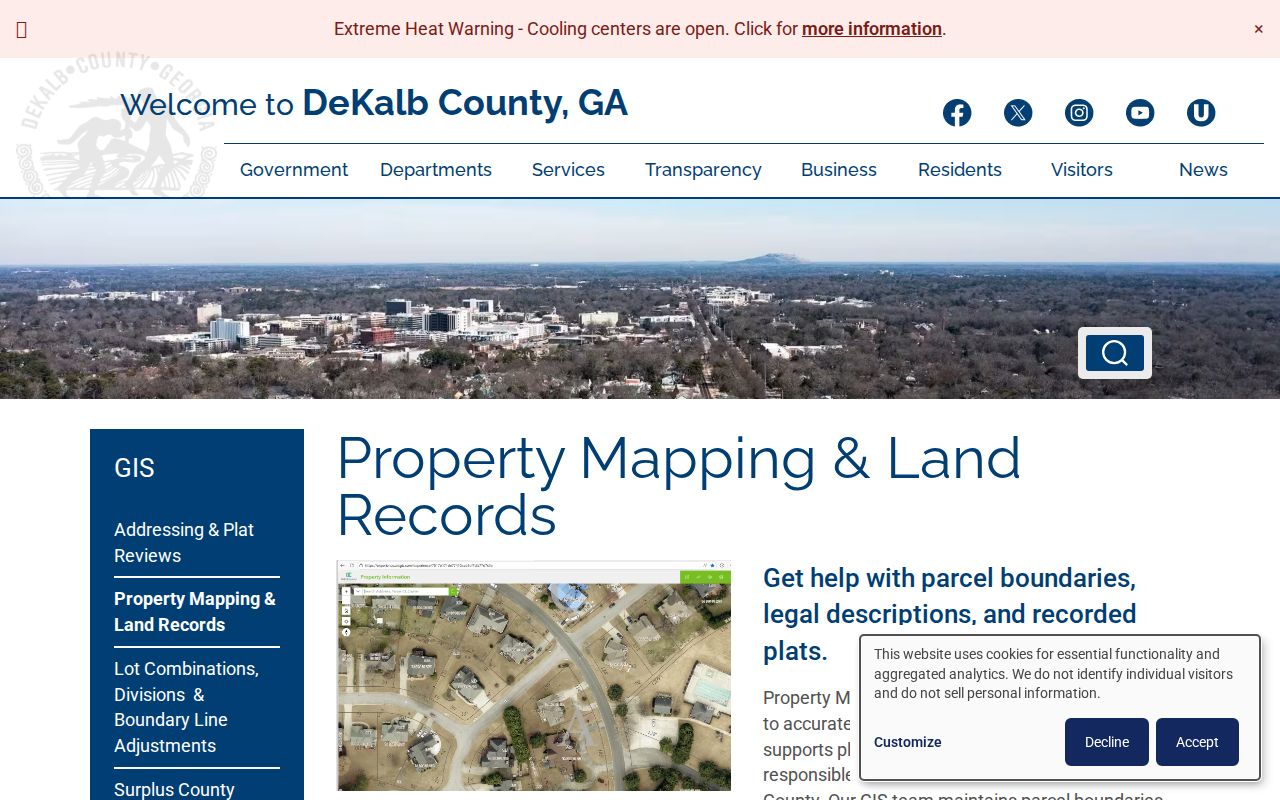
Its division of duties prevents a map display from being mistaken for an official deed or survey.
Chamblee Court Records Routes
Court custody follows jurisdiction. Chamblee Municipal Court handles city ordinance and traffic matters, and Georgia has no single statewide traffic-ticket database. County cases go to Superior, State, Magistrate, or Probate Court based on case type and amount. Superior Court handles felony, divorce, major civil, family, and property matters. State Court handles misdemeanor, DUI, traffic, and civil claims up to $45,000. Magistrate covers civil claims up to $15,000 plus garnishments, warrants, and foreclosures. Probate handles estates, guardianships, and marriage licenses.
The official Georgia Courts eAccess directory points to the DeKalb Superior and State provider and notes that an account is required. An e-filing system is not the same as open access to every docket or image. Juvenile, adoption, sealed, and protected family material will not appear as ordinary public files.
The captured court eAccess directory shows where county-specific systems are listed.
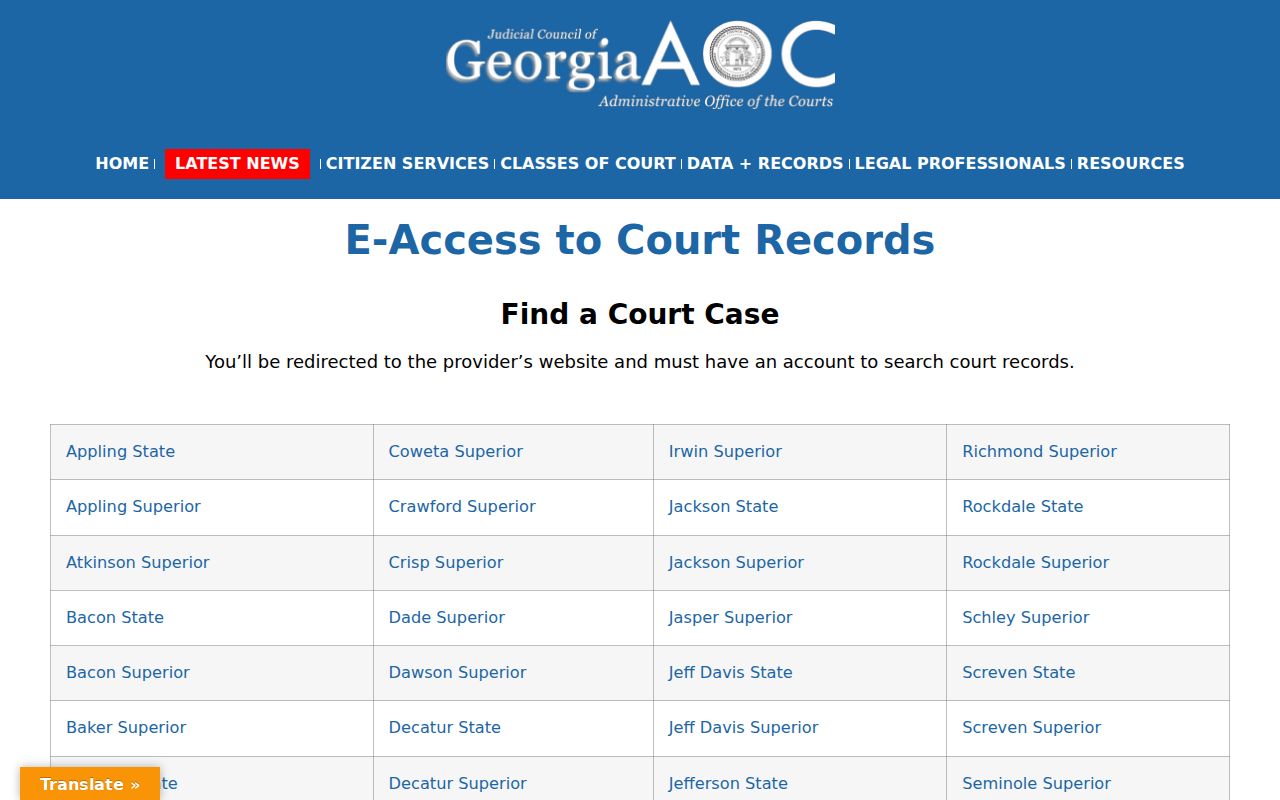
When online access stops, contact the correct clerk and provide the party name, case number if known, case type, and approximate filing period.
Older Chamblee Records Leave the Web
Closed Superior civil files from 2012 and earlier move through Clerk Archives. Older cases may require a warehouse pull and more time. A mailed request needs the archive form, the correct fee, a self-addressed stamped envelope, and return contact information. Payment is by money order or cashier’s check.
A final judgment or decree costs $5, or $10 with a settlement agreement. A certified archived trade name costs $2.50. A pre-1990 case request is $20, made up of $15 for research and $5 for certification. Broad name-only requests may be impractical, so provide case details whenever possible.
- Index
- A finding aid that points to a filing and its identifiers.
- Certified copy
- A copy formally authenticated by the records office.
- Custodian
- The agency or official responsible for keeping and producing a record.
- Exemption
- A legal rule that permits or requires information to be withheld.
Chamblee Vital Records Access
Vital certificates use a specialized process, not a general open-records request. Georgia DPH holds births and deaths from January 1919 forward, and any county vital office may issue a Georgia birth or death certificate. Records before 1919 lead to the event county and Georgia Archives.
Birth certificates are not public under O.C.G.A. §31-10-26. An eligible requester must show a qualifying relationship, valid photo identification, and any needed linking document or authorization. Certified death copies require a direct and tangible interest, though the public may obtain a plain-paper death record with the Social Security number redacted. DPH covers marriages from June 1952 through August 1996; DeKalb Probate handles other periods, while divorce decrees remain Superior Court files.
The official Georgia vital-record request page lays out the application channels.
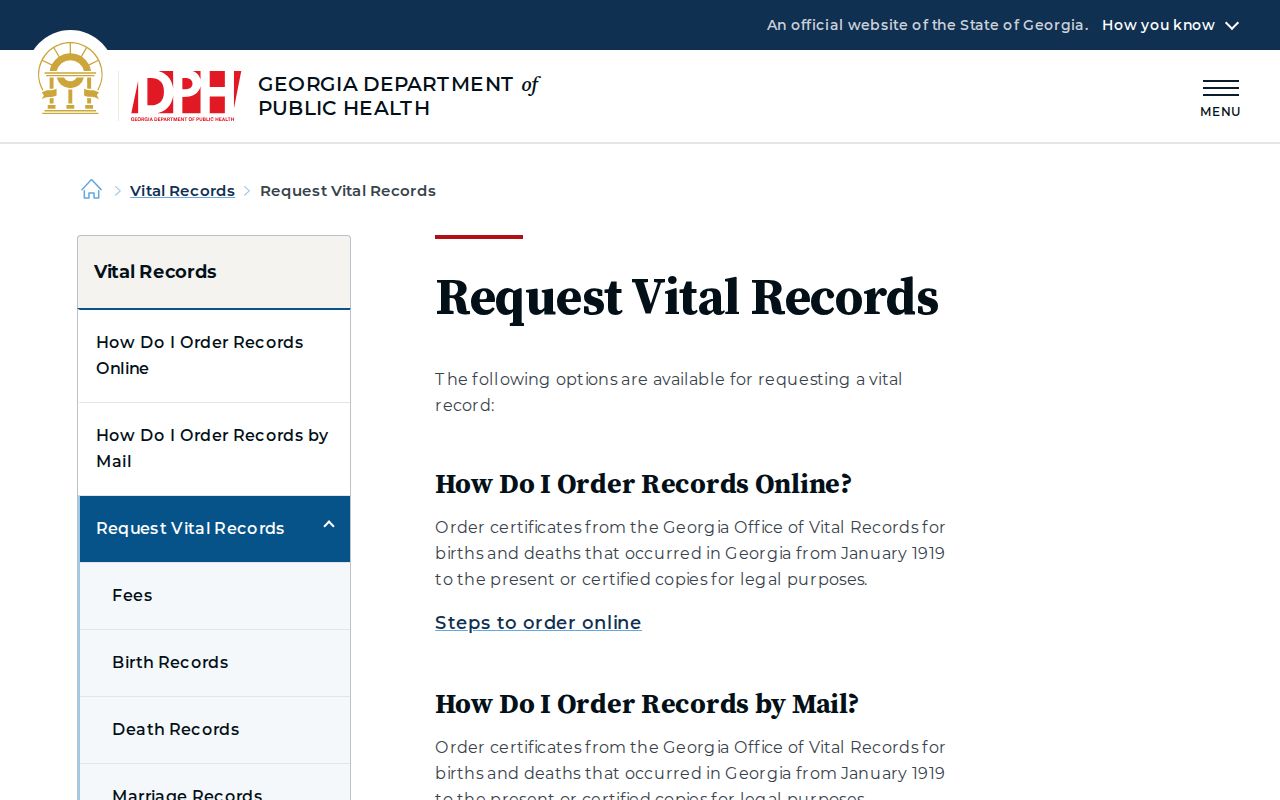
This screen matters because access depends on certificate type, relationship, identity proof, and delivery method rather than a public name index.
Chamblee Public Records Offices
No single desk controls all Chamblee public records. City administrative files stay with Chamblee. The county clerk, appraisal offices, and courts are centered in Decatur because Chamblee is not the county seat. These contacts cover the main routes documented for local searches.
Chamblee City Records
City departments and GovQA
City government gateway
DeKalb Real Estate Division
556 N. McDonough Street, ground floor, Decatur, GA
404-687-3812
Clerk real-estate access
DeKalb Property Appraisal
Owner, address, parcel, values, and characteristics
404-371-2468
Property search and values
DeKalb Police Records
Incident and police-report requests
770-724-7474
DKPDOpenRecords@dekalbcountyga.gov
The Real Estate research room is open Monday through Friday, 8:30 a.m. to 4:30 p.m. Deputies can help at the counter, but the office will not research documents by telephone. The city’s GovQA session path can rotate, so the city government Open Records link is the safer entry.
The captured Chamblee GovQA request center shows the city’s online intake route.
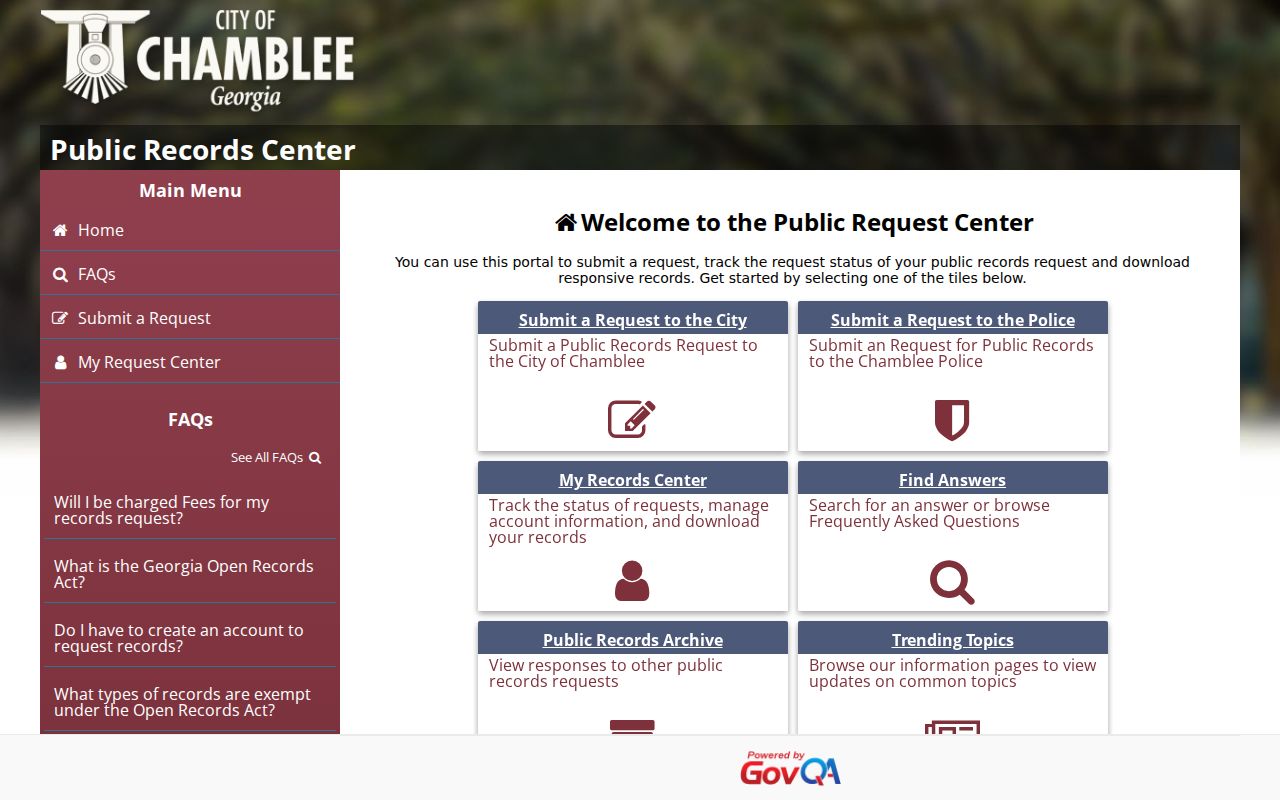
Because the session-bearing path may change, begin at Chamblee’s durable city gateway if that direct page no longer opens.
Georgia Rules for Chamblee Records
The Georgia Open Records Act, O.C.G.A. §§50-18-70 through 50-18-77, lets any person request an existing agency record without a Georgia residency requirement. A written request gives both sides a clear scope. Within three business days, the agency should produce available records or state the timetable, estimated cost, and exact exemption supporting any withholding.
Agencies need not create a new report. Existing electronic data and simple printouts can still be records, so ask for native electronic form when practical. Labor for search, review, redaction, and production is tied to the lowest-paid qualified full-time employee selected by the custodian, and the first 15 minutes are free. Ordinary letter or legal paper copies generally may not exceed 10 cents per page unless another law sets a special fee. Prepayment can apply when an estimate exceeds $500 or prior lawful fees remain due.
The captured Georgia Attorney General open-government guidance gives the state’s working explanation of these duties.
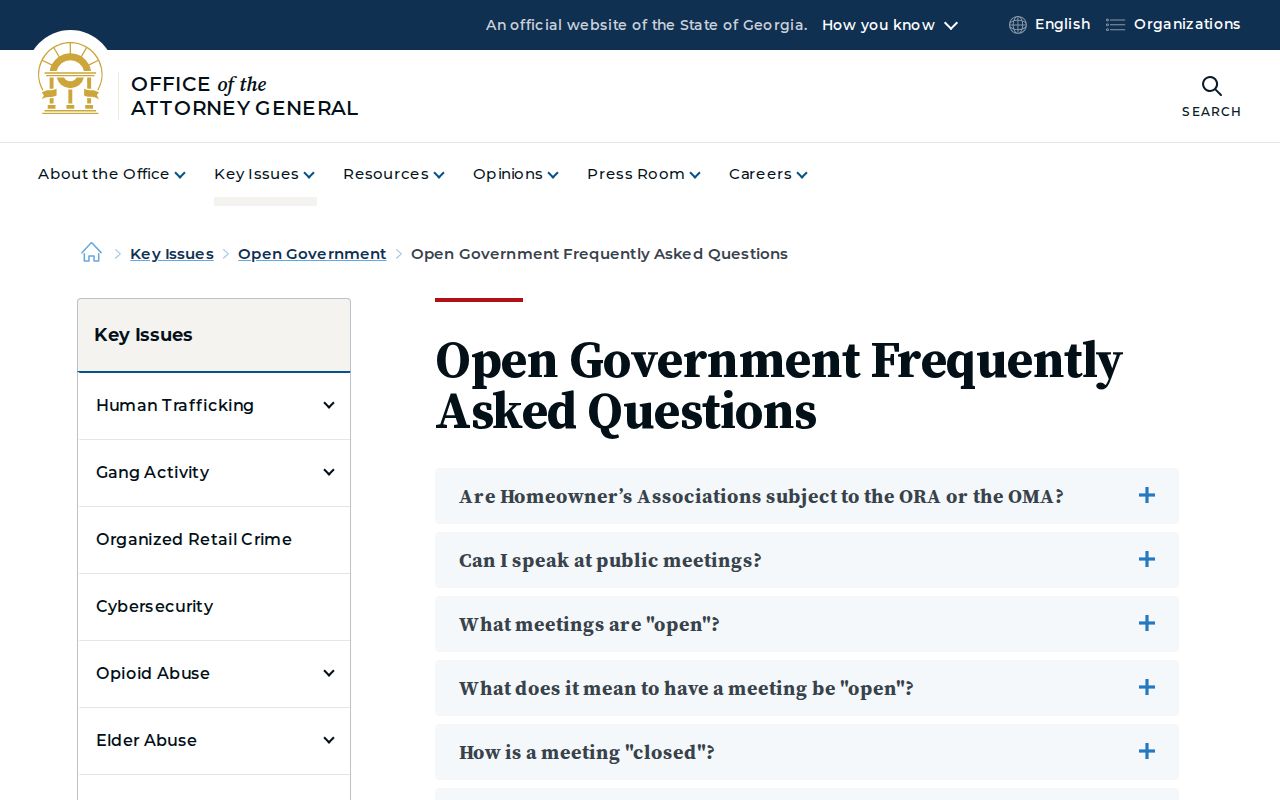
That source is also the route to the Attorney General’s mediation process when a denial or delay cannot be resolved with the custodian.
Chamblee Record Copies and Fees
General Act fee rules do not replace special schedules. DeKalb land-record copies cost $1 per page, while plats cost $2 per page. A certified deed copy costs $2.50 for the first page and 50 cents for each added page. Mail requests need a book type and page; a UCC request needs the full UCC number. The clerk accepts cashier’s checks, money orders, or attorney checks for those mail routes.
Electronic certification is available through the statewide GSCCCA service, which requires an account and payment within six days after approval. Vital records have separate published charges. As of March 2026, birth and death certificates start at $25 plus $5 for an added copy; marriage starts at $10 plus $5. Online birth or death orders add processing costs.
Choose the copy that fits. Ask for an itemized estimate, and skip certification when an informational copy will meet the lawful personal need.
Native CSV can preserve searchable fields in a table. PDF works for fixed documents, and the original image format may best retain a scan. Narrow dates, addresses, and record types because redaction time can become the largest part of a broad estimate.
Chamblee Records After the 1842 Fire
DeKalb County was formed in 1822, but a courthouse fire on January 9, 1842, destroyed nearly all earlier official records. The only known official survivor is Superior Court Book A, covering 1836 through 1843, which was reportedly away with the clerk. This loss creates a real boundary for Chamblee-area land, court, and family research.
A second courthouse fire in 1916 damaged the 1898 building, yet fireproof safes protected most older records. Stories about card games, a cigar, or an election dispute remain folklore or theories, not established causes. For early gaps, the proper fallback is not a modern portal. DeKalb History Center holdings, Georgia Archives, plats, newspapers, census material, and later deeds may supply indirect evidence.
Landmark’s alpha books and electronic index mark another boundary: 1961-1977 scans, then 1979 onward electronically. These dates explain why counter and archive access remain part of Chamblee records research.
Protected Addresses in Chamblee Records
Safe at Home launched July 1, 2026, under O.C.G.A. §50-18-150 and following sections. It gives qualifying survivors a substitute address for most state and local records, First-Class mail forwarding, and protected voter registration. Applicants use a sworn statement and ordinarily work with a registered Advocate Assistant.
VoteSafe is narrower. Under O.C.G.A. §21-2-225.1, qualifying protective-order holders and family-violence shelter residents apply through the county registrar. Voter address records become confidential for four years, with renewal required, and a county move calls for a new application. The two programs should not be treated as one system.
These protections mean a substituted address can be correct as an official public-facing value without showing a person’s actual residence. Respecting that boundary is essential when records from several agencies are compared.
File a Chamblee Records Request
Requesting Chamblee public records works best when the request names an existing record instead of asking an agency to research or write a narrative. A permit register for one address and date range is clearer than a request asking who worked at the property. For DeKalb police reports, include the incident number, address, date, and parties when known.
- Identify the real custodian. Confirm city limits and the date involved before choosing Chamblee or DeKalb County.
- Check the official index first. Save a book and page, Parcel ID, case number, or incident number that will narrow the request.
- Describe the existing record, date range, and desired native electronic format in writing. Ask for an estimate before paid work begins.
- Review any three-business-day reply for the production date, itemized cost, or precise exemption citation. Narrow the scope if cost or redaction is high.
- If a denial remains unresolved, ask the custodian to reconsider and then use Georgia Attorney General mediation or court enforcement as appropriate.
The DeKalb open-records page routes requests by department rather than through one catch-all county custodian.
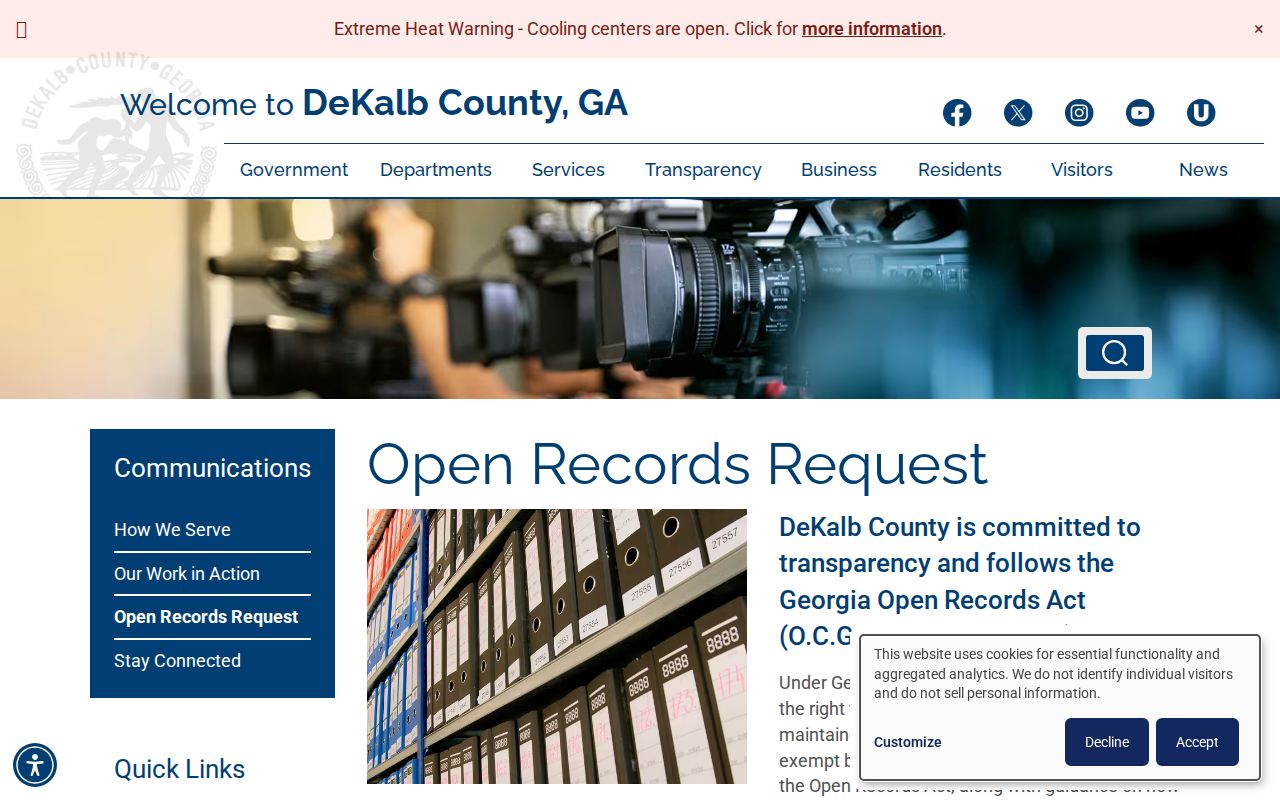
That department-by-department approach helps a request reach the office that can search, redact, and produce the actual file.
Lawful personal use. Public access is not consent to follow, threaten, or harass a person. Georgia stalking law, O.C.G.A. §16-5-90, still applies.